
At Boone Insurance Group, we're seeing how ai in property insurance underwriting is revolutionizing risk assessment. Instead of using only historical data, AI analyzes granular, real-time information—from satellite imagery to public records—to build a dynamic risk profile for your property. This leads to more accurate, fair, and personalized insurance pricing.
Table of contents
- What is AI-Powered Property Risk Assessment?
- How Does AI Underwriting Differ from Traditional Methods?
- What Real-World Data Does AI in Property Insurance Underwriting Actually Use?
- What Are the Benefits of AI Underwriting for Policyholders?
- Are There Downsides to Using AI in Property Insurance Underwriting?
- Frequently asked questions
What is AI-Powered Property Risk Assessment?
AI-powered property risk assessment uses artificial intelligence, particularly machine learning models, to analyze vast and diverse datasets to predict the likelihood and potential severity of loss for a specific property. Unlike a static checklist, these models learn from millions of data points, identifying complex patterns and correlations invisible to the human eye. For instance, an AI might identify a subtle link between a specific roofing material, the average wind speed in a microclimate, and the frequency of claims after a storm, allowing for a much more precise risk calculation than simply noting the age of the roof.
This shift transforms underwriting from a reactive practice rooted in history to a proactive, predictive one. It's about understanding not just what has happened in a neighborhood, but what is likely to happen to a specific structure given its unique combination of features and environmental exposures.
How Does AI Underwriting Differ from Traditional Methods?
AI underwriting fundamentally differs from traditional methods by replacing static, generalized risk pools with dynamic, individualized risk profiles. These profiles are built using a much wider array of real-time and granular data. While a traditional underwriter relies on established tables and applicant-provided information, an AI system synthesizes information from dozens of sources in near real-time. This shift dramatically improves the speed, accuracy, and personalization of the entire process.
Here’s a direct comparison of the two approaches:
| Feature | Traditional Underwriting | AI-Powered Underwriting |
|---|---|---|
| Data Sources | Credit score, ZIP code, age of home, claims history | Aerial/satellite imagery, public permit data, IoT sensor readings, hyper-local weather models, LiDAR elevation data |
| Risk Assessment | Categorical; based on historical averages and broad risk pools | Predictive; based on specific property attributes and dynamic environmental factors |
| Process Speed | Can take days or weeks, often requiring a manual inspection | Can generate a bindable quote in minutes or hours |
| Personalization | Low; your property is grouped with others that seem similar | High; the premium is calculated based on your property's unique risk profile |
| Risk Mitigation | Reactive; advice is often given after a claim occurs | Proactive; can identify specific risks (e.g., tree overhang) and suggest mitigation for better rates |
What Real-World Data Does AI in Property Insurance Underwriting Actually Use?
The power of ai in property insurance underwriting lies in its ability to ingest and analyze diverse, real-world data sources that go far beyond a standard application form. These systems build a multi-dimensional view of a property, creating a far more accurate picture of its true risk.
Key data sources include:
- Geospatial and Aerial Imagery: High-resolution images from satellites, airplanes, and drones are fed into computer vision models. These AIs are trained to identify and assess key property features, such as roof condition (looking for missing shingles, pooling water), the presence of undeclared structures like pools or trampolines, yard debris that could pose a fire hazard, and the proximity of large trees to the home. This provides a current, objective view that's more reliable than an owner's memory or outdated records, directly impacting your Arizona homeowners insurance assessment.
- Public Records and Building Permits: AI systems can automatically scan municipal databases for building permits. This reveals crucial information about the property's history and condition. For instance, a permit for a new roof or updated electrical system indicates a lower risk than the home's age might suggest, while a history of code violations could signal deferred maintenance.
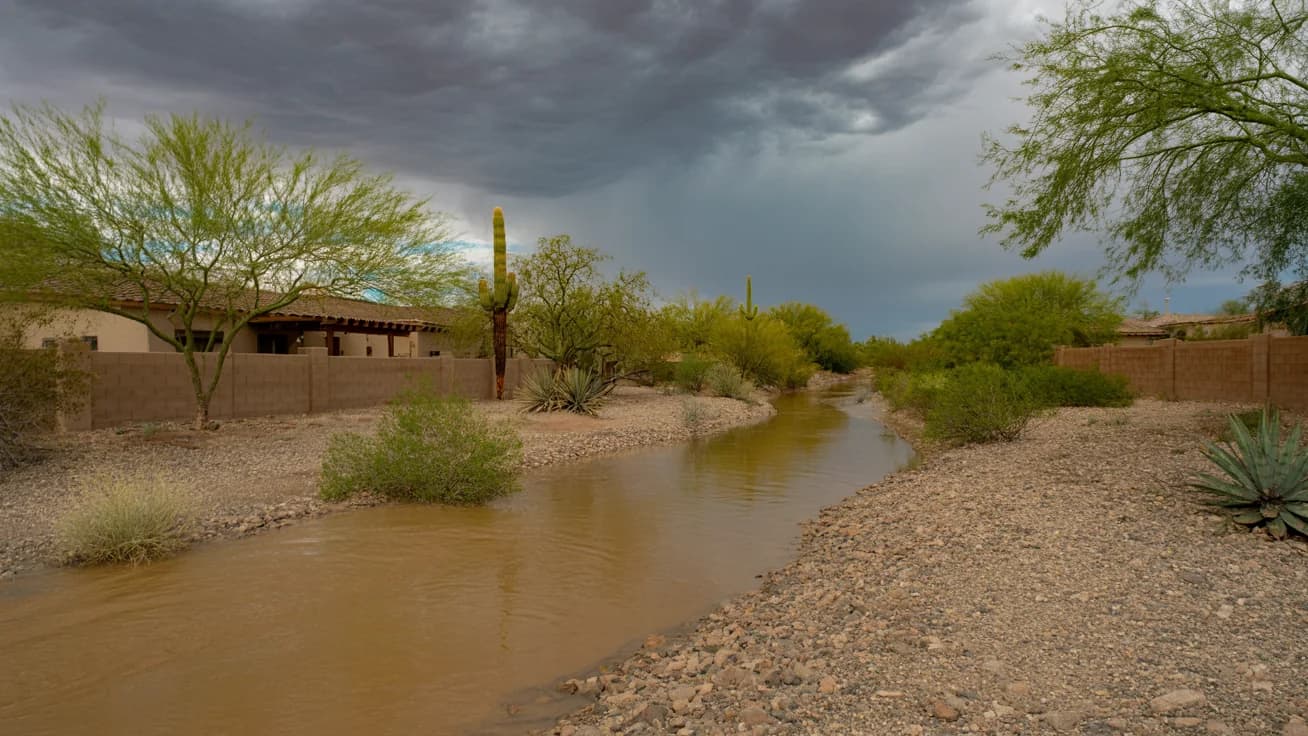
- Hyper-Local Environmental Data: Instead of using a broad ZIP code to determine environmental risk, AI leverages sophisticated models that analyze risk at the property level. This includes high-resolution wildfire risk maps based on vegetation and topography, granular flood zone data that accounts for local elevation, and predictive models for hail, wind, and other weather events. For a state like Arizona, understanding specific exposure to flash floods is critical, making this data invaluable for policies like flood insurance in Arizona.
- Internet of Things (IoT) Data: For commercial properties and increasingly for homes, data from connected devices offers a real-time window into risk. Information from smart water leak detectors, automatic shut-off valves, and monitored security systems can feed directly into the underwriting model, often qualifying the property owner for significant discounts on their business insurance Arizona policy.
What Are the Benefits of AI Underwriting for Policyholders?
For policyholders, the primary benefits of AI-driven underwriting are faster quoting, more accurate and potentially lower premiums, and personalized risk management advice. The technology translates complex data into tangible advantages.
First, the speed and convenience are dramatically improved. Because AI gathers and analyzes data automatically, you can get a firm, bindable quote in a fraction of the time it took with traditional methods, which often required manual data entry and a physical inspection.
Second, it promotes fairer pricing. With traditional underwriting, your premium is heavily influenced by the claims history of your general area. If you've meticulously maintained your property but live in a ZIP code with many claims, you're often penalized. AI's property-specific analysis allows your individual efforts—like installing a new roof or clearing brush—to be recognized and rewarded with a premium that reflects your actual risk, not your neighbor's.
Finally, AI enables proactive risk mitigation. The same tools that identify risks for pricing can be used to help you prevent losses. An insurer might be able to say, "Our model shows the large oak tree over your garage increases your risk profile. If you have it trimmed, we can reduce your premium." This transforms the insurance relationship from a purely financial transaction to a partnership in safety and prevention.
Are There Downsides to Using AI in Property Insurance Underwriting?
Yes, the main downsides to consider with ai in property insurance underwriting revolve around data privacy, the potential for algorithmic bias, and the complexity of appealing an AI-driven decision. While the technology offers immense benefits, it's crucial to acknowledge its challenges.
Data privacy is a significant concern. These systems rely on vast amounts of information about properties and, by extension, their owners. Reputable insurers must adhere to strict data protection laws and employ robust cybersecurity to safeguard this sensitive information.
Algorithmic bias is another critical issue. If an AI model is trained on historical data that contains biases (for example, data reflecting past redlining practices), it can unintentionally learn and perpetuate those same biases, leading to unfairly high rates in certain communities. The insurance industry and regulators are actively developing standards for auditing these algorithms to ensure fairness and prevent discriminatory outcomes.
Finally, the "black box" problem can make it difficult to understand or challenge a decision. When a complex model denies coverage or sets a high premium, it may not be immediately clear which specific factors led to that outcome. This is where a skilled insurance agent becomes more important than ever. An agent at Boone Insurance Group can be your advocate, working with the carrier to understand the decision, correct any inaccurate data, and explore alternative coverage options.
While the world of insurance is changing, our commitment to personalized service remains constant. An AI-generated number is a starting point, not the final word. If you have questions about how these advancements affect your policy or want an expert to ensure you're getting the most accurate and fair rate for your Arizona property, contact the team at Boone Insurance Group today for a comprehensive review.
Frequently asked questions
Will AI replace my insurance agent?
No, AI is a tool that enhances, not replaces, an insurance agent. While AI handles data analysis for underwriting, a human agent provides crucial context, advocacy, and personalized advice that algorithms cannot. They help you navigate complex choices and understand your coverage.
Can AI underwriting lower my insurance premiums?
It can, but it isn't guaranteed. If your property has lower-than-average risk (e.g., a new roof, defensible space against wildfires), AI's granular analysis can result in a lower premium. Conversely, if it identifies previously unknown risks, your premium could be higher.
Is my personal data safe with AI underwriting systems?
Reputable insurance carriers and agencies are bound by strict data privacy regulations to protect your information. AI systems are built with robust security measures, and data is typically anonymized and aggregated during the model training process to safeguard individual privacy.
How does AI handle unique or unusual properties?
This is an area where AI can struggle and human oversight is essential. For properties with unique construction, historical significance, or other non-standard features, a traditional underwriting approach supplemented by an agent's expertise is often necessary to ensure accurate valuation and coverage.
Does AI impact the claims process too?
Yes, AI is also transforming claims. It can be used to assess damage from photos or drone footage (triage), detect fraudulent claims, and speed up payments for straightforward losses, getting policyholders back on their feet faster.